

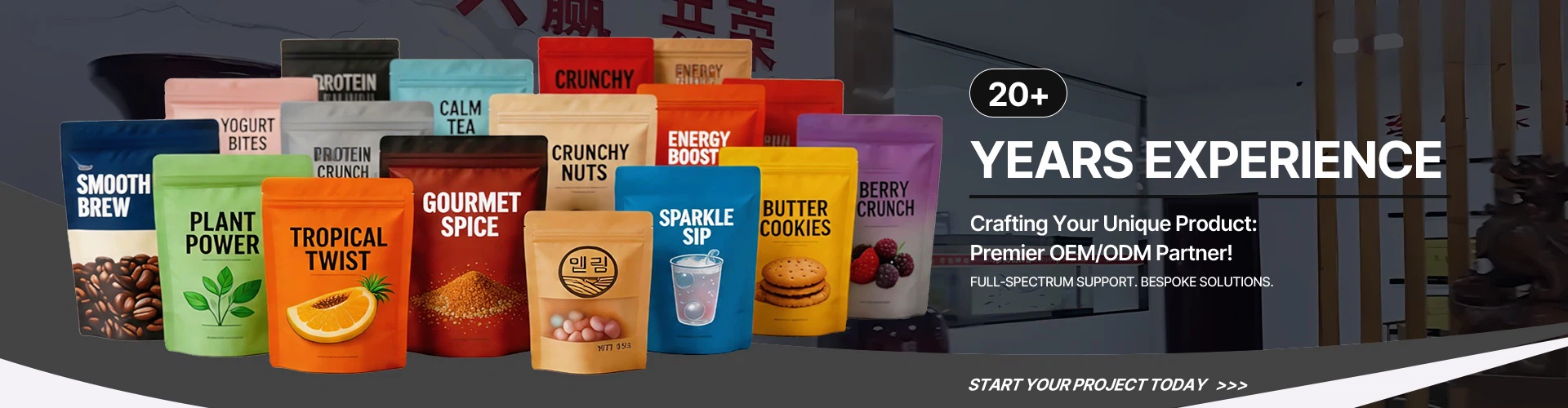
Abstract:When you hold a beautifully designed and highly functional custom packaging bag in your hand, you are holding a part of a complex journey that combines materials science, printing technology, and precise manufacturing. This article will deeply analyze the entire process of a high-performance custom packaging bag from concept to completion, revealing the technical core behind it.

Phase 1: Blueprint Planning and Structural Design
This is the foundation of the project. All subsequent processes are based on the output of this stage.
1. Demand Analysis: Clearly define the physical and chemical properties of the contents (such as moisture-proof, oxygen-blocking, and light-shielding requirements), the compatibility of the packaging machinery (filling speed, heat sealing parameters), and the market positioning.
2. Structural Design: Based on the requirements, design the structure of "multi-layer co-extruded film" or
"dry composite film". For example, a high barrier packaging bag might adopt a structure such as "PET/AL/CPP" or "PET/VMPET/PE", where "VMPET" (aluminum-coated polyester film) provides excellent barrier properties and metallic luster.
3. Graphic Design: Complete the decoration design of the packaging and perform color separation based on the printing process, and output the electronic files that meet the plate-making requirements.
Phase 2: Prepress Preparation and Material Preparation
Transform the design blueprint into a physical carrier that can be put into production.
4. Introducing Gravure Plate Making / Digital Printing
5. Base Material Treatment: Perform "corona treatment" on the film base material (such as BOPP, BOPET, CPP, etc.) to increase its surface tension, thereby enhancing the adhesion of the ink and coating.

Phase 3: Core Processing - Printing and Functional Layer Preparation
At this stage, the appearance and core functionality of the packaging bag are both defined.
6. Intaglio Printing / Digital Printing
7. Vacuum Aluminum Coating: If an aluminum coating effect is desired, the printed substrate will enter the "vacuum aluminum coating machine". Under high vacuum conditions, the metal aluminum wire is heated to vaporization, allowing it to uniformly deposit on the film surface, forming a nano to micro-level "aluminum coating layer". This layer significantly enhances the barrier properties (oxygen barrier, moisture resistance, light protection) and metallic texture of the packaging.
Phase 4: Combinatorial and Solidification - Constructing Multi-Layer Structure
Integrate multiple functions into a single, sturdy unit.
8. Dry-lamination: Using polyurethane adhesive, the printed/aluminized layer is bonded to the inner layer material (such as PE, CPP) serving as the heat-sealing layer on a dry-lamination machine. The process involves applying the adhesive, drying, and then heat-pressing for lamination.
9. Curing: The semi-finished rolled product is sent to the "curing chamber", where it is exposed to specific temperature and time to allow the adhesive to fully cross-link and cure, achieving the final "strength".

Phase 5: Finalization and Strict Quality Control
Transform the large rolls of composite materials into the final packaging bag products.
10. Cutting: After the wide and thick roll has been matured, it is cut into narrow rolls of specific widths on the cutting machine according to the requirements of the bag size.
11. Bag Making: On the fully automatic bag-making machine, the material is sealed and cut with precise heat sealing knives, and functions such as zipper installation, tear-off opening punching, and exhaust hole drilling may be integrated.
12. Final Inspection and Packaging:
Physical Performance Testing: Test the sealing strength, heat sealing strength, impact resistance to pendulum, etc.
Barrier Performance Testing: Use oxygen permeability meters and moisture permeability meters to verify the oxygen barrier (OTR) and moisture barrier (WVTR) properties.
Appearance Inspection: Check for printing defects, stains, and registration deviations under standard light sources.
Qualified products are counted, packaged, and stored in the warehouse, waiting for shipment.
Summary
What we sell is not just the packaging; it's the "essence" of the product that is dressed in high-end attire!