

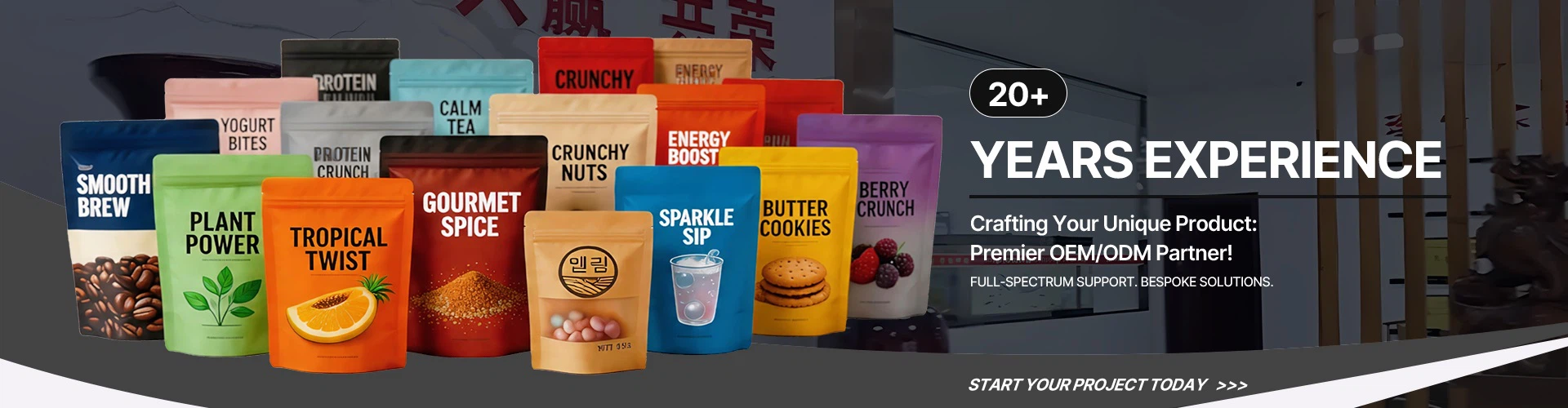
As a form of flexible packaging widely used in food, daily chemicals, medicine and other fields, the appearance design of stand-up bags not only carries the brand recognition function, but also directly affects consumers' purchasing decisions. As the market's requirements for packaging portability, environmental protection and visual appeal continue to increase, the appearance characteristics of stand-up bags have gradually become the focus of industry attention.
From a structural point of view, the most notable feature of stand-up bags is the support design at the bottom. The reinforced bottom surface formed by the heat sealing process allows the package to be placed upright without relying on external force, greatly improving the display efficiency. This structure is usually made of multi-layer composite materials, which not only ensures load-bearing stability, but also takes into account barrier properties, effectively extending the shelf life of the product. Some high-end stand-up bags will also add anti-slip patterns or groove designs on the bottom to further optimize stacking stability.
In terms of visual performance, the plane space of stand-up bags provides ample display opportunities for brands. Modern stand-up bags generally use high-definition printing technology, support CMYK four-color or even spot color printing, and can accurately restore complex patterns and gradient effects. Designers often use the main display area on the front of the bag for product close-ups, while the side is used to mark ingredients, instructions for use and other information. It is worth noting that more and more brands are beginning to use special materials such as matte film or pearlescent film to enhance shelf appeal through the dual stimulation of touch and vision.
Functional details are also an important part of the appearance design of self-supporting bags. Common opening forms include zipper, nozzle and flip-top. These designs are not only convenient for repeated use, but their metallic snaps or frosted opening parts can also enhance the overall texture. Some self-supporting bags will add a transparent window on the top, which not only maintains the uniformity of the material, but also solves the need for visualization of the contents.
With the popularization of environmental protection concepts, the appearance of self-supporting bags is also developing in a sustainable direction. The use of degradable materials allows packaging to reduce environmental burden while maintaining beauty, while the simplified graphic design reduces the amount of ink used. These innovations show that the appearance characteristics of self-supporting bags are evolving from a single functional carrier to an important medium connecting brand value and consumer experience.